Welcome
  • Home
  • Blog
  • Shop
  • About
  • Contact
  • 0
Author

Daily Aromatics

Daily Aromatics

Essential OilsFeatured

Dilution Guide for Essential Oils

by Daily Aromatics April 13, 2026

When you’re getting started with essential oils, dilution can feel like one of the most confusing pieces.

But it doesn’t have to be complicated.

Think of dilution as a way to use essential oils effectively while being gentle on your body. Essential oils are highly concentrated plant extracts, and a little truly goes a long way.

These charts are here to give you a simple, practical reference point—not rigid rules. Every person (and every body) is different. The most important thing you can do is pay attention to how you respond and adjust accordingly.

A good rule of thumb?
Start low and go slow. You can always add more, but you can’t undo too much.


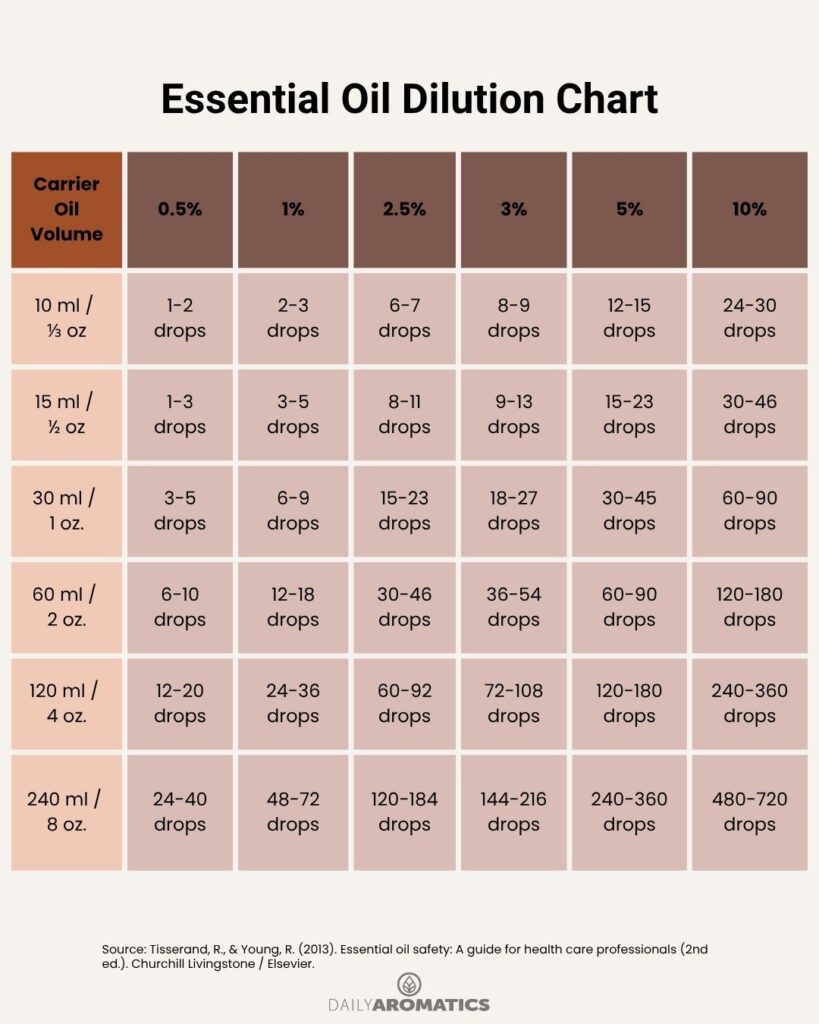
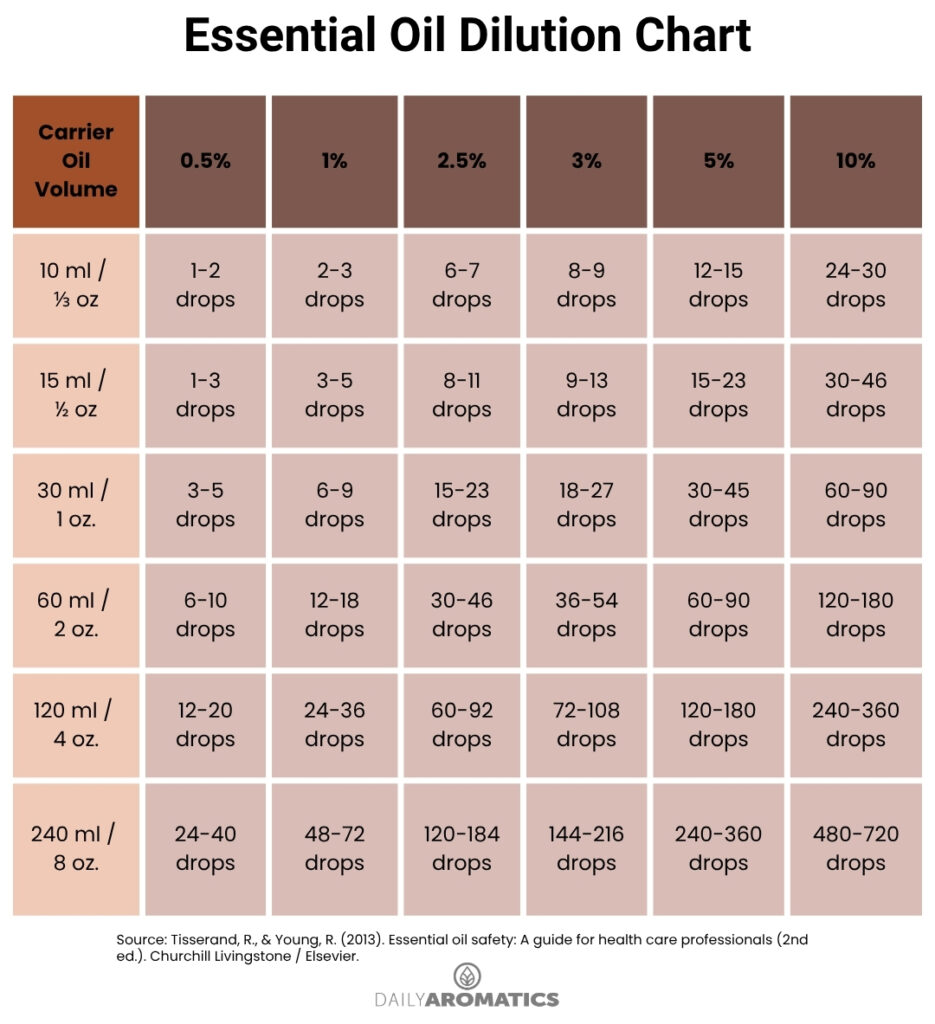
Essential Oil Dilution Chart

This chart is your quick reference for how many drops of essential oil to use based on your carrier oil amount and desired dilution percentage.

Dilution simply means mixing essential oils with a carrier oil (like coconut oil, olive oil, or jojoba) before applying them to the skin. This helps:

  • Reduce the risk of skin irritation
  • Improve absorption
  • Make your oils last longer
  • Allow for more consistent, even application

You’ll notice a range of dilution percentages—from very low (0.5–1%) to more concentrated (5–10%).

For most everyday uses, a 1–3% dilution is more than enough. Higher dilutions (5–10%) can be appropriate in certain situations, but are typically used short-term and with intention, rather than daily use.

This chart gives you the numbers—but your body gives you the feedback.

Suggested Applications for Dilution

Not all dilution levels are meant for the same purpose, and this chart helps take the guesswork out of when to use each range.

Lower dilutions (0.25–1%) are best for:

  • Babies, elderly individuals, or those with sensitive skin
  • Facial care
  • Daily, long-term use

Moderate dilutions (2–5%) are ideal for:

  • General wellness support
  • Massage oils
  • Occasional, targeted use

Higher dilutions (5–10% and above) are typically reserved for:

  • Short-term, targeted concerns
  • Specific areas of the body
  • Situations where more intensive support is needed

It’s important to remember that more is not always better with essential oils. Often, lower dilutions used consistently are both effective and gentler on the body.


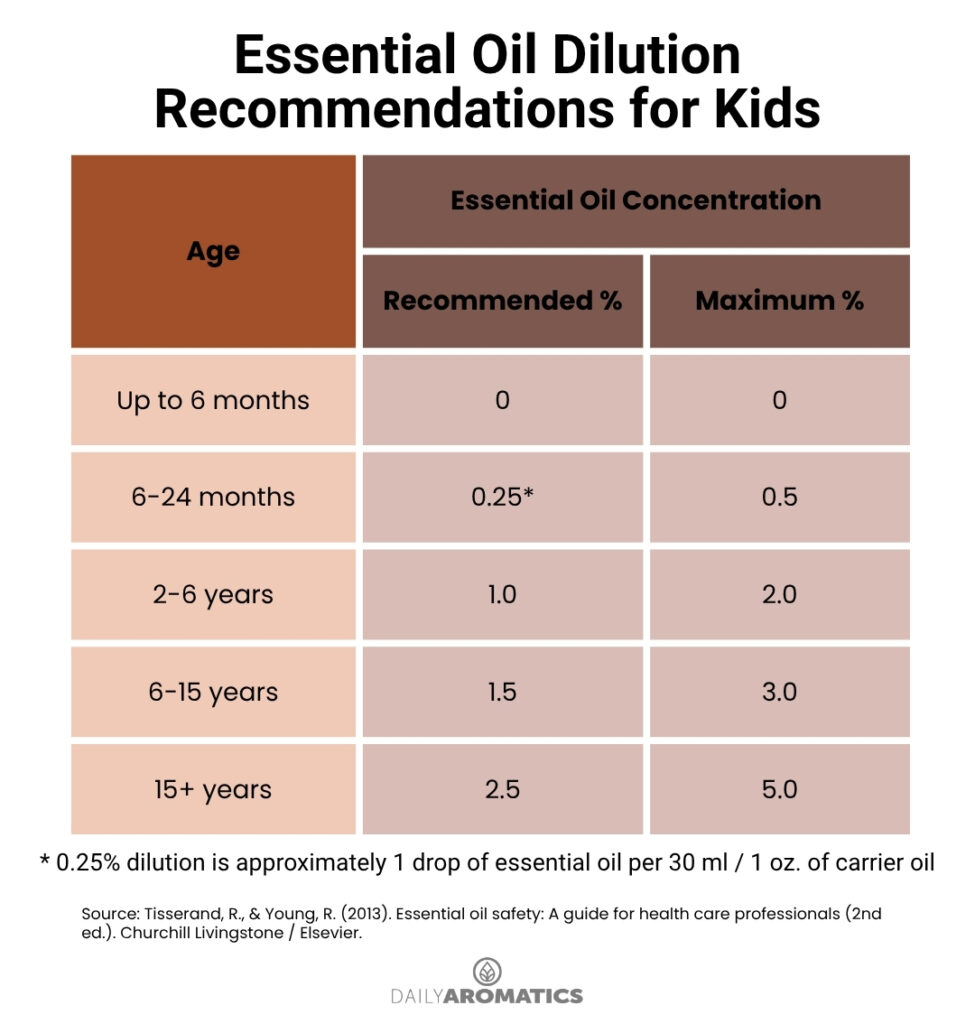
Dilution Recommendations for Kids

When it comes to children, dilution becomes even more important.

Children’s bodies are still developing, and they tend to be more sensitive to essential oils. Using lower dilutions helps you support them safely while still benefiting from the oils.

A few key things to keep in mind:

  • Always dilute more than you would for yourself
  • Start with the lowest recommended dilution
  • Use gentle, child-friendly oils
  • Avoid daily long-term use of the same oil without breaks

This chart gives age-based guidelines to help you feel more confident, but again—your child’s response matters most.

Important Note on Sensitization

One of the main reasons we dilute essential oils is to help prevent something called sensitization.

Sensitization happens when the body becomes reactive to an oil over time—often from using too much, too often, or applying it undiluted. It can show up as skin irritation or a reaction to an oil that previously felt completely fine.

The goal isn’t to create fear—but awareness.

By using proper dilution, rotating oils, and giving your body breaks when needed, you can continue to enjoy essential oils long-term without issue.


Closing

These charts are here to simplify things—but they’re not meant to replace your intuition.

Essential oils are a beautiful tool for supporting your home and health, and when used thoughtfully, they can be both effective and incredibly gentle.

If you’re ever unsure:

  • Start with a lower dilution
  • Test on a small area
  • Observe how your body responds

Over time, you’ll build confidence—and using essential oils will begin to feel second nature.
0 comments
0 FacebookTwitterPinterestEmail
Essential OilsFeatured

Essential Oil Safety

by Daily Aromatics April 13, 2026

A Practical Guide for Confident, Everyday Use

What Makes Essential Oils So Potent?

Essential oils aren’t just fragrant—they’re chemically complex.

Each oil contains dozens (sometimes hundreds) of naturally occurring compounds like:

  • Monoterpenes (fresh, uplifting, fast-acting)
  • Alcohols (generally gentle and skin-friendly)
  • Phenols and aldehydes (more reactive and potentially irritating)

Because of this concentration and complexity, essential oils interact quickly with the body—through both the skin and the olfactory system.

That’s why safety isn’t about fear—it’s about respecting their potency.


Dilution: The Foundation of Safe Use

Dilution isn’t just about “stretching” your oils—it’s about how your body processes them.

When essential oils are applied neat (undiluted):

  • They absorb rapidly into the bloodstream
  • They can overwhelm the skin’s natural barrier
  • They increase the risk of sensitization (a delayed allergic-type reaction over time)

Carrier oils slow this process down. They:

  • Reduce the concentration of reactive compounds
  • Support more even absorption
  • Help protect the skin’s lipid barrier

This is especially important for oils high in more reactive constituents.


“Hot Oils” & Skin Sensitivity

Some essential oils feel warm—or even irritating—on the skin. This isn’t random.

It comes down to their chemistry.

Key compounds to understand:

  • Phenols (e.g., eugenol in clove, carvacrol in oregano)
  • Aldehydes (e.g., cinnamaldehyde in cinnamon, citral in lemongrass)

These compounds are:

  • Highly antimicrobial
  • Very active biologically
  • More likely to irritate skin and mucous membranes

That’s why oils like oregano, clove, cinnamon bark, and thyme (thymol) require much lower dilution.

Even oils like lemongrass (high in citral) can feel surprisingly strong despite smelling fresh and citrusy.

Practical takeaway:

It’s not the oil itself that’s “harsh”—it’s the chemical profile.

Used correctly, these oils can be incredibly beneficial. They just require:

  • Lower dilution (often 0.5–1%)
  • More mindful application
  • Occasional, not daily, use

Phototoxicity: Why Some Oils Don’t Mix with Sunlight

This is one of the most important (and misunderstood) safety topics.

Certain essential oils—especially cold-pressed citrus oils—contain compounds called:

Furanocoumarins

These compounds can:

  • Absorb UVA light
  • Become activated on the skin
  • Trigger a reaction that damages skin cells

This can lead to:

  • Redness or burns
  • Blistering
  • Long-lasting hyperpigmentation

Oils most commonly involved:

  • Bergamot
  • Lemon
  • Lime
  • Grapefruit

Key nuance:

  • This risk applies to topical use only
  • It is most significant with cold-pressed oils
  • Steam-distilled citrus oils typically have little to no phototoxic risk

Simple guideline:

Avoid direct sunlight or UV exposure on areas where these oils were applied for 12–24 hours.


Inhalation & Diffusing Safety

When you diffuse essential oils, you’re inhaling microscopic aromatic compounds that interact directly with the brain through the olfactory system.

This is what makes aromatherapy so effective—but also why moderation matters.

Overexposure can lead to:

  • Headaches
  • Nausea
  • Dizziness
  • Sensory overwhelm

This is especially true for:

  • Children
  • Sensitive individuals
  • Those new to essential oils

Why intermittent diffusing works:

Your body responds quickly to aromatic input. Continuous exposure doesn’t necessarily increase benefit—it can actually reduce sensitivity over time.


Babies & Children

Children are not just “small adults.” Their bodies process essential oils very differently, which is why extra care is needed.

Their skin is thinner and more permeable, their respiratory systems are still developing, and their detoxification pathways are not as mature. Because of this, certain essential oil compounds can feel much stronger—or even overwhelming—to a child’s system.

One of the most important things to understand here is the role of specific chemical constituents.

Compounds like 1,8-cineole (found in eucalyptus and some rosemary oils) and menthol (found in peppermint) can have a strong effect on the respiratory system. In young children, especially under the age of 6, these compounds may slow breathing or create a sensation that is too intense for their airways.

Because of this, many experts recommend avoiding these oils for young children—particularly around the face and chest—until at least age 6.

Instead, focus on gentler oils that are well tolerated.

Safer choices for young children (properly diluted):

  • Lavender
  • Roman chamomile
  • Frankincense
  • Sweet orange

Practical safety tips:

  • Keep dilution low (0.25–1%)
  • Avoid applying near the nose, mouth, or chest
  • Start with small amounts and observe closely
  • Use inhalation or diffusion before topical use when possible

Pregnancy

Pregnancy is a time to be both empowered and cautious.

Essential oils can cross into the bloodstream and, in some cases, may cross the placental barrier. While this doesn’t mean they are unsafe, it does mean that intentional, conservative use is important.

Some essential oils are best avoided during pregnancy due to their potential to stimulate uterine activity or because of their chemical composition.

Oils commonly recommended to avoid (especially in early pregnancy):

  • Clary sage
  • Cinnamon bark
  • Cassia
  • Oregano
  • Thyme (thymol chemotype)
  • Rosemary (high camphor types)

At the same time, many oils are considered gentle and supportive when used properly.

Generally considered safer options (in low dilution):

  • Lavender
  • Frankincense
  • Lemon (watch phototoxicity if topical)
  • Ginger (especially for nausea support)

The key here is simplicity.

Best practices during pregnancy:

  • Use low dilutions (around 1% or less)
  • Avoid daily, long-term use of strong oils
  • Stick to a small number of well-tolerated oils
  • Prioritize aromatic use (diffusing or inhalation)

Elderly

As we age, our bodies change in ways that affect how we respond to essential oils.

Skin becomes thinner and more permeable, meaning essential oils are absorbed more quickly. At the same time, liver and kidney function—which help process and eliminate compounds—may be less efficient than in younger years.

This doesn’t mean essential oils shouldn’t be used. In fact, they can be incredibly supportive. It simply means that a gentler approach is often best.

Helpful adjustments for older adults:

  • Use lower dilutions (around 1% or less)
  • Apply to smaller areas of the body
  • Avoid frequent reapplication throughout the day
  • Be mindful of medications or existing health conditions
  • Choose gentler oils over more stimulating or “hot” ones

A slower, simpler approach tends to be both safer and more effective.


Pets & Essential Oils

Animals process essential oils very differently than humans.

For example:

  • Cats lack certain liver enzymes needed to metabolize compounds found in essential oils
  • Dogs have a much stronger sense of smell and can be easily overwhelmed

This means oils that feel mild to us can be intense—or even harmful—for them.

Especially important:

  • Avoid applying oils directly to pets without proper knowledge
  • Be cautious with diffusing in enclosed spaces
  • Watch for behavioural changes (leaving the room, agitation, lethargy)

Sensitive Individuals

Some people are more reactive due to:

  • Chemical sensitivities
  • Allergies
  • Previous overexposure

Sensitization is especially important to understand here.

What is sensitization?

It’s not an immediate reaction—it develops over time when the immune system becomes reactive to a substance.

Once it happens, even small amounts can trigger irritation.

This is why:

  • Dilution matters
  • Rotating oils can be helpful
  • More is not better

Internal Use

Essential oils are highly concentrated chemical substances.

When taken internally:

  • They are absorbed rapidly
  • They interact directly with internal organs
  • Improper use can increase risk of irritation or toxicity

This route requires a much deeper understanding of:

  • Dosage
  • Oil chemistry
  • Individual health considerations

For most people, aromatic and topical use provide more than enough benefit.


Storage, Shelf Life & Oxidation

There’s a common belief—especially in some essential oil communities—that essential oils “never go bad.”

This isn’t true.

Essential oils are made up of natural chemical compounds, and over time, those compounds begin to change—especially when exposed to oxygen, heat, and light. This process is called oxidation.

Oxidation doesn’t just affect how an oil smells—it changes how it behaves on the skin.

Oxidized oils are significantly more likely to:

  • Cause skin irritation
  • Contribute to sensitization
  • Lose their therapeutic qualities

This is especially important for oils that are high in monoterpenes, which are more chemically reactive and prone to breaking down over time.

Even when stored properly, these oils have a shorter shelf life.

Common monoterpene-rich oils (shorter shelf life):

  • Lemon
  • Lime
  • Sweet orange
  • Grapefruit
  • Bergamot
  • Tangerine
  • Pine
  • Spruce
  • Fir
  • Tea tree

General shelf life guidelines:

  • Citrus oils: ~1–2 years
  • Conifer oils (pine, spruce, fir): ~2–3 years
  • Tea tree: ~2–3 years

Other oils (especially those rich in alcohols or sesquiterpenes) may last significantly longer—but no essential oil lasts forever.

Practical storage tips:

  • Keep bottles tightly closed (oxygen exposure speeds oxidation)
  • Store in a cool, dark place
  • Avoid heat and direct sunlight
  • Consider replacing frequently used citrus oils more often

A helpful mindset shift:
Fresh oils are not just more fragrant—they are safer for your skin.


Full Disclaimer

This content is for educational purposes only and is not intended as medical advice. I am not a licensed medical professional, and the information shared here is not meant to diagnose, treat, cure, or prevent any disease.

Essential oils are powerful natural substances and should be used with care and respect. Every individual is different, and what works well for one person may not be appropriate for another.

If you are pregnant or breastfeeding, have a medical condition, are taking medications, or are caring for young children, elderly individuals, or pets, please consult with a qualified healthcare provider before using essential oils.

By using essential oils, you accept full responsibility for your own health and well-being.

0 comments
0 FacebookTwitterPinterestEmail
DIYEssential OilsNatural Home

Spring Room Sprays + Diffuser Blends

by Daily Aromatics March 29, 2026

Spring has arrived — but if you live somewhere like I do, that doesn’t always mean it feels like spring just yet. There can still be snow on the ground, grey skies overhead, and a heaviness lingering from the winter months. But here’s the thing…Even when the weather hasn’t caught up, we can begin to shift the feeling inside our homes. And one of the simplest ways to do that? —> Scent.

Why Scent Matters More Than You Think

Scent is one of the fastest ways to change how a space feels. It doesn’t require a full home refresh or a big seasonal reset — just a few intentional drops of plant-based aroma can:

  • Uplift the mood of a room
  • Create a sense of freshness and movement
  • Help your home feel lighter, cleaner, and more aligned with the season

In many ways, scent helps us move. Out with the stale —> in with the fresh! And that shift is exactly what spring is all about.


Spring Calls for Lighter, Fresher Aromas

During the winter, we naturally gravitate toward:

  • Warm
  • Deep
  • Grounding scents

But spring invites something different. This is the season for:

  • Bright citrus
  • Fresh herbs
  • Soft florals
  • Clean, airy blends

These types of scents help create a feeling of:

  • Renewal
  • Energy
  • Gentle movement

Not overwhelming or sharp — just fresh and alive.


How to Make a Simple Room Spray

Room sprays are one of the easiest ways to quickly refresh a space.

Basic Room Spray Recipe (100 mL bottle)

  • 70 mL distilled water
  • 30 mL witch hazel (unscented)
  • 25 drops essential oils

Add everything to a glass spray bottle and shake gently before each use.

Room sprays are perfect for:

  • Entryways
  • Bathrooms
  • Bedrooms
  • Linens
  • Quick resets throughout the day

Spring Room Spray Blends

Here are three simple blends inspired by the feeling of spring:

Sunlit Citrus Grove

Bright • Energizing • Uplifting

  • 10 drops Sweet Orange
  • 7 drops Lemon
  • 4 drops Bergamot FCF
  • 3 drops Rosemary
  • 1 drop Frankincense

This blend feels like sunshine pouring into your home — fresh, clean, and full of energy.


Garden Awakening

Green • Fresh • Revitalizing

  • 8 drops Lemon
  • 6 drops Lavender
  • 5 drops Basil
  • 4 drops Peppermint
  • 2 drops Cedarwood

This one has a soft herbal freshness — like stepping into a garden just beginning to come to life.


Soft Forest Breeze

Grounding • Clean • Airy

  • 8 drops Black Spruce
  • 6 drops Lemon
  • 5 drops Eucalyptus radiata
  • 4 drops Lavender
  • 2 drops Cedarwood

A beautiful balance between fresh and grounding — perfect if you still want a bit of that cozy feeling while transitioning into spring.


Diffuser Blends for a Spring Reset

Diffusing is another powerful way to bring seasonal scents into your home. Unlike room sprays, diffusers create a more continuous and subtle atmosphere. Here are a few simple spring-inspired blends:

  • Lemon + Lavender
  • Grapefruit + Cypress
  • Bergamot + Geranium
  • Peppermint + Rosemary
  • Lemon + Black Spruce
  • Lavender + Eucalyptus

Use 3–6 drops total depending on your diffuser size.


Room Sprays vs Diffusing

Both are incredibly useful — they just serve different purposes.

Room Sprays

  • Quick and immediate
  • Great for targeted areas
  • Perfect for refreshing linens or a specific room

Diffusers

  • Slow and continuous
  • Ideal for setting the overall mood of your home
  • Great for longer periods of time

I like to think of it this way:

  • Room sprays = quick reset
  • Diffuser = steady atmosphere

A Simple Way to Welcome Spring In

You don’t need to overhaul your home to welcome a new season.

Sometimes, it’s as simple as:

  • Opening a window
  • Letting in fresh air
  • And choosing scents that reflect where you’re heading

Spring is a time of movement, renewal, and gentle energy.

Let your home reflect that.

Out with the stale, in with the fresh.

0 comments
0 FacebookTwitterPinterestEmail
  • 1
  • 2

About Me

About Me

About the Author

Hi, I’m Amy — a certified aromatherapist, herbal enthusiast, wife, mother, and dairy farmer passionate about simple, plant-based living. Here I share essential oil education, herbal recipes, botanical skincare, and practical ways to support a healthier, more natural lifestyle through the power of plants.


Newsletter

Natural living inspiration, herbal recipes, and essential oil education — straight to your inbox.

Thank you!

You have successfully joined our subscriber list.

Instagram

Recent Posts

  • The Essential Oils I Reach for Most for Skin Care

  • How to Make Calendula Salve (And Why It’s One of the Herbal Remedies I Recommend You Keep in Your Home)

  • Natural Home: Creating a Cleaner, Calmer Home with Simple Plant-Based Alternatives

  • Seasonal Support: Working with Nature Throughout the Year

  • My Favourite Essential Oils for Beginners

Categories

  • Botanical Skincare (4)
  • DIY (2)
  • Essential Oils (10)
  • Featured (3)
  • Gardening (1)
  • Herbalism (5)
  • Natural Home (3)

Quick Links

About
Blog
Contact
Privacy Policy
Disclaimer
Instagram Facebook

Stay Connected

Natural living inspiration, herbal recipes, and essential oil education — straight to your inbox.

Thank you!

You have successfully joined our subscriber list.

Featured Posts

My Favourite Essential Oils for Beginners
Dilution Guide for Essential Oils
Essential Oil Safety

© 2026 Daily Aromatics. All Rights Reserved.

  • Home
  • About
  • Contact
  • Blog
  • Privacy Policy
  • Disclaimer
Welcome
  • Home
  • Blog
  • Shop
  • About
  • Contact

Shopping Cart

Close

No products in the cart.

Close